
“Life isn’t about finding yourself, or finding anything. Life is about creating yourself. And creating things.” – Bob Dylan
I’ve attended many shows at the legendary Birchmere, located just outside Washington, DC. The Birchmere catered to, and still does to a lesser degree, a clientele seriously interested in folk and bluegrass music. Whereas most clubs emphasized mirth and merriment, the Birchmere always puts the music first.
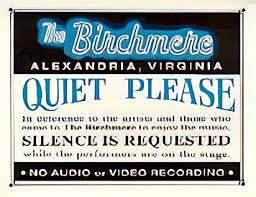
You might not guess that the DC area was once a hotbed for country, folk, and bluegrass music, but it does make sense. Being the home of the federal government, the area has long been an economic powerhouse. During the Depression and into the WW II era DC drew many job seekers from the relatively close and economically challenged Appalachian region. They brought their music with them. Over time, a fan base grew. The Birchmere opened its door in 1966 and quickly became the place to hear that kind of music.
The club has reside in multiple locations. The present one opened in 1997. It’s a sort of fancy place that holds about five hundred people. It has the typical high, bare ceiling of a modern restaurant. The menu features craft beers and salads. The average patron’s salary is easily over a hundred grand.
The previous location, just down the street from the new one, had none of these amenities. It was an old timey place. Plastic, red checkerboard table cloths. Wrinkled black and white 8x10s of former acts on the walls. The food tasted of microwave. No craft beers and few imports. It was the perfect place to see the subject of this appreciation, the great John Hartford.
Harford (Chet Atkins later suggested adding a “t”) was born in New York City in 1937. His father was a doctor, his mother an artist with a musical bent. Both were avid square dancers, which no doubt influenced Hartford’s music and stage performance (see videos below). They moved to St. Louis, Missouri shortly after his birth. Hartford would develop a deep and lifelong fascination with the nearby Mississippi River.
After high school, he attended a local college, the Washington University in St. Louis, graduating with a degree in commercial arts, which would come in handy when he later designed his own album covers. After working on the river and as a local DJ, Hartford moved to Nashville, working again as a DJ and playing music in local clubs. He secured a recording contract with RCA Records thanks to an association with the Glaser Brothers. Hartford said that RCA, like many record companies at the time, was searching for a “new Dylan”, and thought he might be their guy.
Hartford would make six albums with RCA, none commercially successful. The early albums were clearly influenced by Bob Dylan, containing much word play and the occasional attempt at big thoughts. The quality was hit and miss. His great classic, Gentle on My Mind, came out of this time of uneven recordings.
Gentle is a song firmly rooted in its the time: the sixties counter culture, free love, and alternative lifestyles. The narrator’s fond remembrance of his lover rings true. Lyrically, it’s a tour de force, perfectly chosen words from the title all the way through.
Though the wheat fields and the clothes lines
And the junkyards and the highways come between us
And some other woman’s cryin’ to her mother
‘Cause she turned and I was gone
I still might run in silence, tears of joy might stain my face
And the summer sun might burn me ’til I’m blind
But not to where I cannot see you
Walkin’ on the back roads, by the rivers flowing gentle on my mind
Glen Campbell, then a relative unknown, heard the tune and, together with session musicians The Wrecking Crew, recorded the classical pop version. The recording made both his and Hartford’s careers.
The folk duo The Smothers Brothers asked Hartford to join the writing staff of their TV variety show. Later, Glen Campbell got this own show and asked Hartford to be a recurring performer, singing his own material and also accompanying Campbell. The show was a hit. However unlikely, Hartford became something of a household name.
Following his brief bout with mainstream fame, Hartford would release his most influential work, Aereo- Plain. Dropping his new Dylan façade, Hartford helped invented a musical style, eventually termed Newgrass, that modernized the staid bluegrass traditions to fit the times. Obviously not as impactful as Dylan’s reworking of rock ‘n’ roll with Bring It All Back Home, but sort of similar. Aereo-Plain took bluegrass music to new places, musically, spiritually and lyrically. Many other artists would follow Hartford’s (and others) lead, including Sam Bush, David Grisman, and Bela Fleck.
Harford would continue in the same vein for decades, eventually releasing many solid albums for the Flying Fish label. He also spent part of each year as a river boat captain on the Mississippi. The rest of the year he recorded and toured at places like the Birchmere.
Later Hartford would focused on preserving and exploring American old-time fiddle and banjo traditions, documenting rare tunes, researching, and designing banjos.
The popular George Clooney film, O Brother, Where Art Thou?, and its soundtrack, Go Tell It On the Mountain, would trigger renewed attention to Hartford. He served as the MC of the Mountain tour which included Emmylou Harris, Allison Kraus, Ralph Stanley and many other big names.
Bob Dylan once said “Life isn’t about finding yourself, or finding anything. Life is about creating yourself. And creating things.” Hartford did that. Early in his career, he seemed to be trying to fit himself into a square hole, trying to write songs with a “deep” meaning that befit the times, trying to be the new Dylan RCA wanted. With the exception of Gentle on My Mind and a few others, it really didn’t work all that well. Few would remember him if he had kept on that same trail.
But he didn’t. Marching to his own drummer, he created his true path. Combining his love for bluegrass, a unique sense of humor, an embrace of the revolutionary times and, oddly enough, his love of the Mississippi River, he made himself into a unique and compelling artist.
We can’t all be artists, but we can all take something from Hartford’s example.
As I mentioned, Hartford’s recordings are a mixed bag. Below are some of the best tracks.
This documentary is a good introduction to Hartford’s life and music.
As I mentioned at the beginning, I saw Hartford on a number of occasions. He was always mesmerizing. His studio recordings pale in comparison. Hartford had an authentic presence that registered with the audience. There was no pretense. He wasn’t playing the part of a river boat captain playing the banjo, he WAS a river boat captain playing a banjo.